|
Summer School
Geometry, Algebra and Combinatorics of Moduli Spaces and Configurations VIII
Dobbiaco (Toblach), June 01-05, 2026
| |
|
This is the 8th edition of the graduate school held in Toblach in winter 2017,
winter 2018, winter 2019, winter 2020, winter 2023, winter 2024 and winter 2025.
There will be three 5 hours minicourses, some talks and ample time for discussion.
|
Mini-courses:
- Ivan Marin, Université de Picardie-Jules Verne, Complex braid groups and their Hecke algebras.
[show abstract]
Abstract:
The generalized braid groups associated with complex reflection groups have been an intense subject of investigation in the past 30 years, in particular in their relation with generalized Iwahori-Hecke algebras because of applications in representation theory.
In this minicourse we shall review the main tools and ideas for using these objects, and apply them to the braid groups of the most common reflection groups. From these first results, we shall then explain how their Hecke algebra can be constructed and studied, and expose the main results on their relation. We shall end with an exposition of several open problems in this area.
[Hide abstract]
- Christian Stump, Ruhr-Universität Bochum, Algebraic and enumerative invariants of finite graded bounded posets (slides1, slides2, slides3).
[show abstract]
Abstract:
In this lecture series, I present classical and modern combinatorial invariants of such posets and their unifying nature across algebraic combinatorics. These invariants include classical structures such as the Möbius function, characteristic polynomial, incidence algebra, chain polynomial, ab-index, and (flag) f- and h-vectors. I also present recently defined families of polynomials associated to such a poset that gained a lot of attention in algebraic combinatorics: the Poincaré-extended ab-index, flag coarse Hilbert-Poincaré series, and Chow polynomial. I discuss their properties such as their unimodality, log-concavity, gamma-positivity, and real-rootedness. Throughout the lecture series, I will in particular discuss known results and conjectures for interesting families of examples: boolean lattices, (ordered) set partition lattices, intersection posets of hyperplane arrangements, lattices of flats of matroids, simplicial posets, shellable posets, and posets that admit R-labelings.
[Hide abstract]
- Mattia Talpo, Università di Pisa, Logarithmic geometry and tropicalization (notes).
[show abstract]
Abstract:
Logarithmic geometry is an enhanced version of algebraic geometry, where varieties are equipped with an extra sheaf of monoids, whose sections should be somehow thought of as ``monomial regular functions’’, and which is essentially of a combinatorial nature. Prototypical examples (and building blocks in some sense) are affine toric varieties. This extra structure is often useful when dealing with degenerations of smooth objects, and, correspondingly, compactifications of certain moduli spaces. There are also fruitful connections to tropical geometry, a piecewise-linear, combinatorial version of algebraic geometry, via a tropicalization procedure, leveraging on the close relationship between a toric variety and its fan. I will give an introduction to these topics and their relationship, also mentioning relevant past and current applications.
[Hide abstract]
|
Talks:
- Lorenzo Giordani, Università di Bologna, Ruhr-Universität Bochum. Chow rings for toric arrangements and operads over Feynman categories.
[show abstract]
Abstract:
In 1995 De Concini and Procesi introduced wonderful models for subspace arrangements and computed their cohomology (and the complement space's) using combinatorial information only. After their seminal work, a number of variations of the theme appeared, from Chow rings for atomic lattices to wonderful models for toric arrangements. The "set" of all possible Chow rings of simple matroids, which specialize to cohomology rings of wonderful models for hyperplane arrangements, was given an operad-like structure in a work by Coron. There, a Koszul duality property was proven, rediscovering the link between Orlik-Solomon algebras and Chow rings. In this talk I will present work in progress where we endow the "set" of all Chow rings for toric arrangements with a structure of an operad over a suitable Feynman category. In particular, we provide a presentation for it in terms of generators and relations. This is work in progress with Moci, Pagaria, Paolini, and Rossi. [Hide abstract]
- Lucrezia Beatrice Lorenzi, SISSA. Bonded links and related algebraic structures.
[show abstract]
Abstract:
In a recent work, Diamandis, Kauffman, and Lambropoulou introduced bonded links: a modern structure in the realm of knot theory, consisting of classical links endowed with embedded arcs with endpoints on the link, called bonds. Analogously to the classical Alexander theorem and the standard closure of braids, which relate classical links to the braid group (on n strands, B_n), in the suitable topological context their algebraic behaviour is described by the monoid of bonded braids (on n strands, BBM_n). The existence of a map BB_n \to B_n, which sends bonds to Artin pure braid generators A_ij, sheds further light on the nature of bonds. Time permitting, we will dwell in motivation for quantum invariants of said objects. Based on a joint work in progress (in the final stages) with Sofia Lambropoulou. [Hide abstract]
- Tommaso Scognamiglio, INDAM, Università di Bologna. Multiplicities for finite reductive groups, Macdonald polynomials and character varieties for Riemann surfaces (slides).
[show abstract]
Abstract:
The representation theory of the finite group GLn(Fq) is well understood, thanks to its combinatorial description (given by Green) and its geometric interpretation due to the results of Deligne and Lusztig.
Still, we have very little understanding of the multiplicities, i.e. of the decomposition of tensor product of irreducible representations.
Hausel, Letellier and Rodriguez-Villegas gave a combinatorial description of the multiplicities in the generic case. This description relates these multiplicities to the cohomology of complex character varieties for GLn(C), i.e. moduli spaces of local systems. The combinatorics appearing in their result is related to Macdonald and Hall-Littlewood polynomials.
In a joint work with Emmanuel Letellier, we try to generalize these results to other groups of type A.
In particular, we study multiplicities for characteristic functions of character sheaves of SLn(Fq), rather than irreducible characters, and relate them to the cohomology of complex character varieties for PGLn(C).
We expect more generally that, for a finite reductive G(Fq), multiplicities should be related to the character varieties for its complex Langlands dual. If time allows, I will point at some combinatorial interpretation of this approach regarding wreath Macdonald polynomials.
[Hide abstract]
Social trip
You can find here information about the social trip.
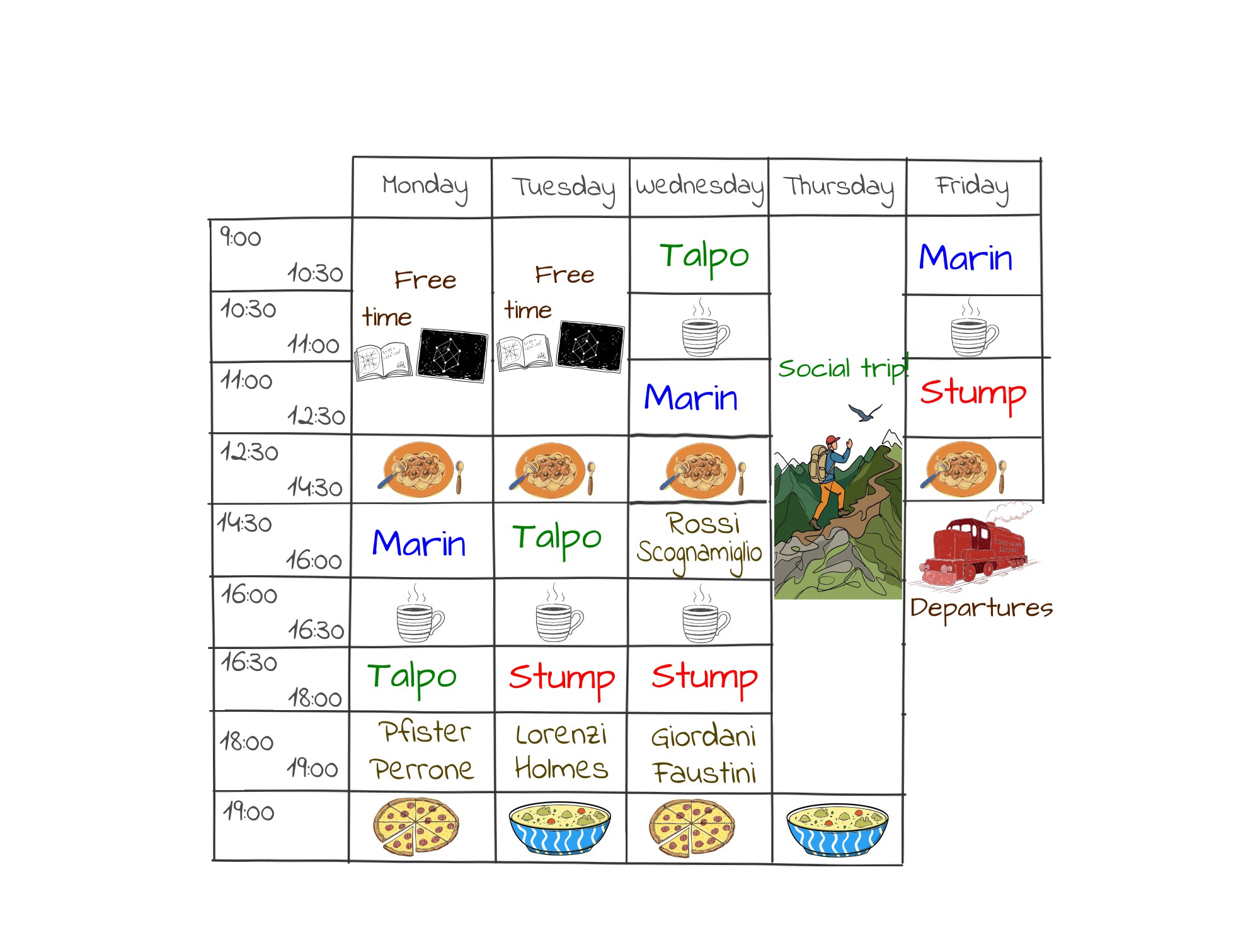
Schedule (updated)
Participants:
- Antonini Federico, Scuola Normale Superiore
- Bianchini Edoardo, Università di Bologna
- Cainelli Eugenio, Università di Bologna
- Caiolo Giovanni, Scuola Normale Superiore
- Callegaro Filippo, Università di Pisa
- Campigli Leonardo, Università di Pisa
- Cartier Matthew, University of Pittsburgh
- Da Col Luca, Università di Trieste
- D'Adderio Michele, Università di Pisa
- Eichberg Marcel, Paderborn University
- Fagiani Ginevra, Università di Pisa
- Faustini Tommaso, University of Warwick
- Ferroni Luis, Università di Pisa
- Foschi Massimiliano, Scuola Normale Superiore
- Franciosi Marco, Università di Pisa
- Gaiffi Giovanni, Università di Pisa
- Garcia Hailey, Louisiana State University
- Giardino Chiara, Ruhr-Universität Bochum
- Giordani Lorenzo, Università di Bologna, Ruhr-Universität Bochum
- Holmes Daniel, ISTA (Institute of Science and Technology Austria)
- Hoster Elena, Ruhr University Bochum
- Interdonato Giovanni, Scuola Normale Superiore
- Jaramillo Puentes Andrés, Università di Catania
- Kettani Ghizlane, Paris University
- Leivaditis Alexandros, Ruhr-Universität Bochum
- Lorenzi Lucrezia Beatrice, SISSA
- Lotti Alice, Università di Pisa
- Luccioli Lorenzo, Università di Bologna
- Marin Ivan, Université de Picardie-Jules Verne
- Mehmood Shahid, Government College University Faisalabad Sahiwal Campus
- Ovalle Alejandro, University of Hannover
- Pagaria Roberto, Università di Bologna
- Papi Paolo, Università di Roma 'La Sapienza'
- Perrone Lorenzo, Università di Bologna
- Pfister Anaëlle, Max Planck Institute for Mathematics in the Sciences
- Riccardi Roberto, Scuola Normale Superiore
- Rossi Tommaso, Università di Bologna
- Ruan Xiabing, University of Strasbourg
- Salvetti Mario, Università di Pisa
- São João José, Université de Strasbourg
- Sassone Antonio, Università di Pisa
- Scognamiglio Tommaso, Indam, Università di Bologna
- Stump Christian, Ruhr-Universität Bochum
- Talpo Mattia, Università di Pisa
- Tavoletti Cosimo Damiano, Scuola Normale Superiore
- Vayalinkal Amalrose, University of Toronto
- Zaccaria Riccardo, Università di Bologna
Venue
The school will be held in Dobbiaco (Toblach) at the Kulturzentrum Grand Hotel Centro Culturale, in "La Sala degli Specchi".
Kulturzentrum Grand Hotel Centro Culturale is located in front of Toblach train station (see the map).
Participants are expected to arrive on Sunday 31/5 and to leave on Friday 5/6 after lunch.
Registration and support
Participants are required to register by filling in this registration form.
It would be very helpful for the organization if you fill in the form as soon as possible, thanks!
Limited funding will be available to cover local expenses (lodging, breakfast and dinner) of few Master or PhD students.
To apply for financial support you are required to fill in the same form.
The deadline to apply for funding is February 28, 2026.
Again, we encourage to apply as soon as possible in order to help the organization, thanks!
For any question, you can contact the organizers at the following email address: toblachconfigurations@gmail.com.
This workshop is supported by:
 MUR, Dipartimento di eccellenza di Matematica, University of Pisa.
 Dipartimento di matematica, Università di Bologna.
 Instituto Nazionale Di Alta Matematica INDAM.
 GNSAGA, INDAM.
 University "La Sapienza" of Rome, Progetti di Ateneo Representation Theory and Applications, 2023-2024.
Organizers:
Filippo Callegaro,
Michele D'Adderio , Luis Ferroni , Marco Franciosi , Roberto Pagaria and Paolo Papi.